
What is Quant?
Our coding agent. It reads your chart, writes and repairs indicator and strategy code, and runs what you approve.
Quant is our coding agent and the intelligence inside LuxAlgo, built into Vela, our next-generation charting platform. It sits next to the chart, reads what's on it, writes and repairs indicator and strategy code, proves it against history, and runs what you approve on the active chart. Ask in your own words or drop a screenshot; no code required.
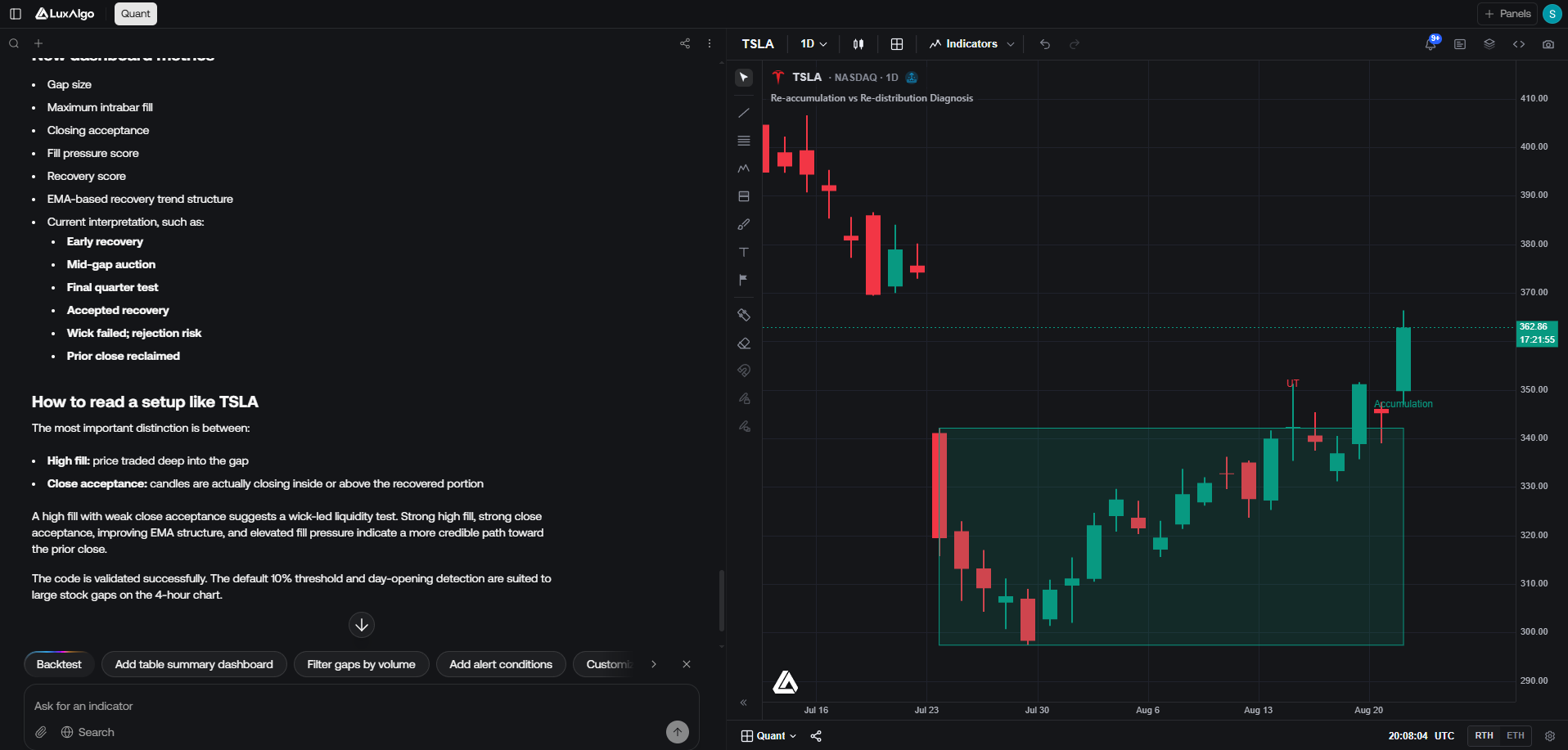
Under the hood, Quant writes Pine Script®, the same scripting language used across the trading industry. Every script Quant produces is real, inspectable code: open Pine editor from the right-hand panel rail to review or edit it, then press Run to execute it against the chart's data. If you already know Pine Script®, you can edit the generated code directly and re-run it; if you don't, you never have to look at it.
One chat can create, edit, and remove multiple scripts, including indicators and strategies. You can also ask Quant to add scripts from the LuxAlgo Library. Scripts Quant creates and edits belong to the workspace until removed; there is no separate step to commit them to the workspace. Find scripts you created with Quant and scripts saved from the Pine editor under My scripts in the Indicators picker. Workspace persistence and saving a reusable script are separate; see Saving scripts.
In a multi-chart layout, Quant always targets the active cell: the chart you last clicked. Its scripts are marked in the chart legend so you can tell them apart from library studies.
Quant code repair is included with Premium, Ultimate, and AI Ultra; every plan includes credits for generating scripts. See Plans for the full comparison.
Try it
Open Vela
Go to vela.luxalgo.com, or click Open Vela in the sidebar. Quant opens beside the chart. You can browse a chart without an account; sign in to run scripts and keep your chat history.
Describe what you want
Type a request in the chat. It can be as simple as "An RSI oscillator with signals" or as specific as describing exact entry conditions, colors, and line styles. You can also paste a screenshot, or select a region on the chart and ask about what's in it.
On an empty chat, the chips under the prompt (Indicator, Strategy, Fix my code, From a screenshot, and Brainstorm) each open a short list of example requests. Picking one fills the prompt without sending it, so you can edit it first.
Review and run
Quant writes the script and plots it on the active chart. Open Pine editor to inspect the Pine Script®, then Run. From here you iterate: ask for changes, create another script, or ask Quant to remove a script in the same chat. Name the script you want to change when the chat contains several.
Ask about the chart
Quant isn't limited to code. Ask it any trading or chart question: what a pattern on the chart means, how an indicator works, or what would confirm or invalidate a setup. When the question is about the chart, Quant looks at the chart first. It answers from what Vela has (price and volume on any symbol and timeframe, and Orderflow from real trades where the market has it) and searches the web for outside facts that change.
Quant analyzes; it doesn't give personal financial advice or promise outcomes, and it treats a backtest as history, not a forecast.
Follow Quant as it works
While Quant works, a live timeline shows each step: thinking, looking things up, writing a script, edits shown as diffs, compile errors, and chart changes. A line at the bottom shows the current step with a timer. Errors switch to Fixed once Quant repairs them. After it writes or edits a script, Quant also sees how the script ran: any runtime errors and, for a strategy, a one-line backtest summary (net P&L, profit factor, trades, and max drawdown). It fixes runtime errors in code it wrote. It never edits a Library indicator it added to the chart; it tells you what needs changing instead. When the reply is done, the timeline folds into a one-line summary such as "Worked for 1m 42s · 1 strategy written · 2 edits"; click it to expand the steps again.
Replies lead with the answer, then use short paragraphs and lists. Caveats are grouped under Notes, and a reply ends with at most one follow-up question.
Control the chart with a prompt
Quant can change the chart as well as write scripts. Ask it to change the symbol, timeframe, chart type, visible range, or multi-chart layout. For example:
- "Switch this chart to AAPL on the daily timeframe."
- "Show the last three months as a line chart."
- "Set up two charts side by side."
Click the chart you want to work on before making a request, and review the resulting chart and settings. If the chat contains several scripts, name the one you want Quant to change.
Model and reasoning
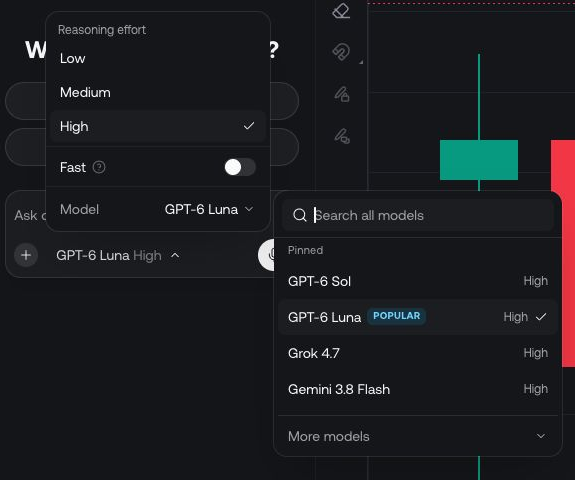
Click the model name below the prompt to open Reasoning effort. Choose an available effort level, or open Model to search the model list. Pin models you use often so they stay easy to find. The available models and effort levels can change; use the picker for the current choices.
The same menu includes Fast. Check the selected model, effort, and Fast setting before sending a request, especially when switching between quick edits and more involved work.
Attachments, web search, and voice
Open + (Add attachments and tools) beside the prompt to attach files or a chart screenshot. When a script is open, the same menu can add it to your favorites.
There is no web search setting to turn on. When a request depends on outside facts that change, such as a prop firm's current rules, Quant searches the web on its own. Its sources appear as links in the reply and in the timeline ("Checked the web for …"); check them before relying on the answer.
The microphone starts voice input so you can dictate a request. Review the transcribed text before sending it. See Making indicators for image input and chart-region capture for a focused crop.
Chat history and placement
When signed in, open Chat history above the conversation to return to a previous chat. Use New Quant chat (+ at the top of the chat) when starting a separate idea, and Chat options › Rename to rename the current chat. Reopening a conversation lets you continue its discussion; Pine editor version history is a separate, temporary session history.
Use Chat options to move Quant to the left or right of the chart. Drag the divider to resize the chat, or use the Quant control in the top bar to show or hide it. On the chart, clicking Quant in the left sidebar reopens a hidden chat and puts the cursor in the prompt.
Credits
Quant runs on monthly credits, one balance shared with the Strategy Screener. Generating and editing scripts consumes credits; bigger requests and longer conversations consume more.
| Plan | Monthly credits |
|---|---|
| Free | 500 |
| Essential | 2,000 |
| Premium | 5,000 |
| Ultimate | 25,000 |
| AI Ultra | 100,000 |
Credits reset on the first of every month. See Monthly credits for credit packs and how plan changes affect your balance.
Long chats consume credits faster, because the whole conversation is context for every new request. Start a new chat around 50 messages, especially when you switch to an unrelated script.
Strategy Screener
Strategy Screener, previously called the AI Backtesting Assistant, sits beside Quant on LuxAlgo. Use it to find strategies built from LuxAlgo toolkit conditions, inspect their backtests, and set strategy alerts. It shares your credit balance with Quant.